


By Chris Watson-James, Head of GTM Technology and Solutions, Innovation Visual
Most marketing leaders I speak to have already bought something. A content platform with AI built in, an email tool that promises to personalise at scale, a CRM add-on that claims to surface buying signals automatically. And in almost every case, the purchase came before the thinking, before anyone had sat down and asked which marketing functions needed transforming, and whether AI was genuinely the right mechanism to do it.
That is not a criticism of those leaders. There is pressure to move quickly with AI, and the vendor community has done an extraordinary job of making every product sound like it solves the exact problem you did not realise you had. But the result is a pattern I see playing out across B2B marketing teams of every size:
- fragmented tool adoption,
- small efficiency gains,
- and a growing sense that AI should be delivering more than it currently is.
This article will help you understand specifically where AI should sit in your marketing function and what to prioritise before you make another investment.
Why the Function-First Approach Is Key
There is a version of AI adoption that looks like progress from the outside but produces very little commercially. Individual team members using ChatGPT to draft copy 10% faster, specialists stretching into generalist territory because AI supposedly makes it easy, leaders buying SaaS platforms with AI features ticked off on the product comparison sheet. Each of these creates a false sense of momentum, and none of them add up to meaningful change at the organisation level.
AI amplifies what already exists in your marketing operation. If your processes are clean, your data is reliable, and ownership is clear, AI will accelerate the outcomes those processes produce. If friction, siloed systems, and ambiguous accountability are the norm, AI will accelerate that just as efficiently!
Mapping your marketing functions before selecting any technology forces a different conversation entirely. Instead of asking which AI tools to buy, you are asking where in your marketing operation time is being lost, quality is being compromised, or scale is being constrained by human capacity. Those are questions your team can answer from direct experience, and the answers tell you exactly where AI investment will generate a return.
Where Marketers Actually Spend Their Time (and Why It Matters)
When I run our Using AI Strategically in Marketing workshop, one of the first things I ask the room is how their marketing team actually spend their day, not what they are supposed to be doing, but what they are genuinely doing when they sit down at their desks. The answers are remarkably consistent regardless of industry or team size.
The majority of marketing time goes to updating the CRM, pulling reports, manually importing data between systems, copying information between tools, manipulating attribution data, briefing colleagues, and doing background research ahead of campaigns or conversations. These are coordination and administration tasks that persist because the systems and processes underneath the marketing function are not working as well as they should be.
This matters for AI mapping because it tells you two things:
-
There is a significant volume of time being lost to work that AI can handle entirely or near-entirely.
-
If those tasks are taking up the majority of your team's day, the strategic work (i.e. content, campaigns, customer insight, commercial decisions) will be getting less attention than it deserves and competitors who have solved this problem will be running ahead.
AI's first and most immediate value in most marketing functions is the elimination of coordination overhead. Not the most glamorous use case, but in most organisations, the highest-return one.
The Strategic Framework: Doing More and Doing Better
Beyond the day-to-day time savings, AI changes what is possible at a strategic level in two distinct ways, and understanding the distinction between them helps you map it to the right functions within your operation.
-
Doing More
-
Doing Better
AI gives marketing teams the ability to operate at a scale, speed, and consistency that human capacity alone cannot sustain. This can be achieved through:
- always-on execution
- the ability to run more experiments simultaneously
- campaigns that do not require someone to be in the office to trigger them
This is the dimension most leaders think of first, and it is valuable, but it accounts for only half of what AI makes possible.
AI enables a quality of personalisation, insight generation, and output consistency that teams struggle to achieve manually, particularly at scale. It provides the ability to:
- tailor messaging to individual contacts based on behavioural signals,
- surface insight from first-party data that would take days to analyse manually,
- ensure brand consistency across high volumes of content output without a separate quality assurance layer sitting across every asset.
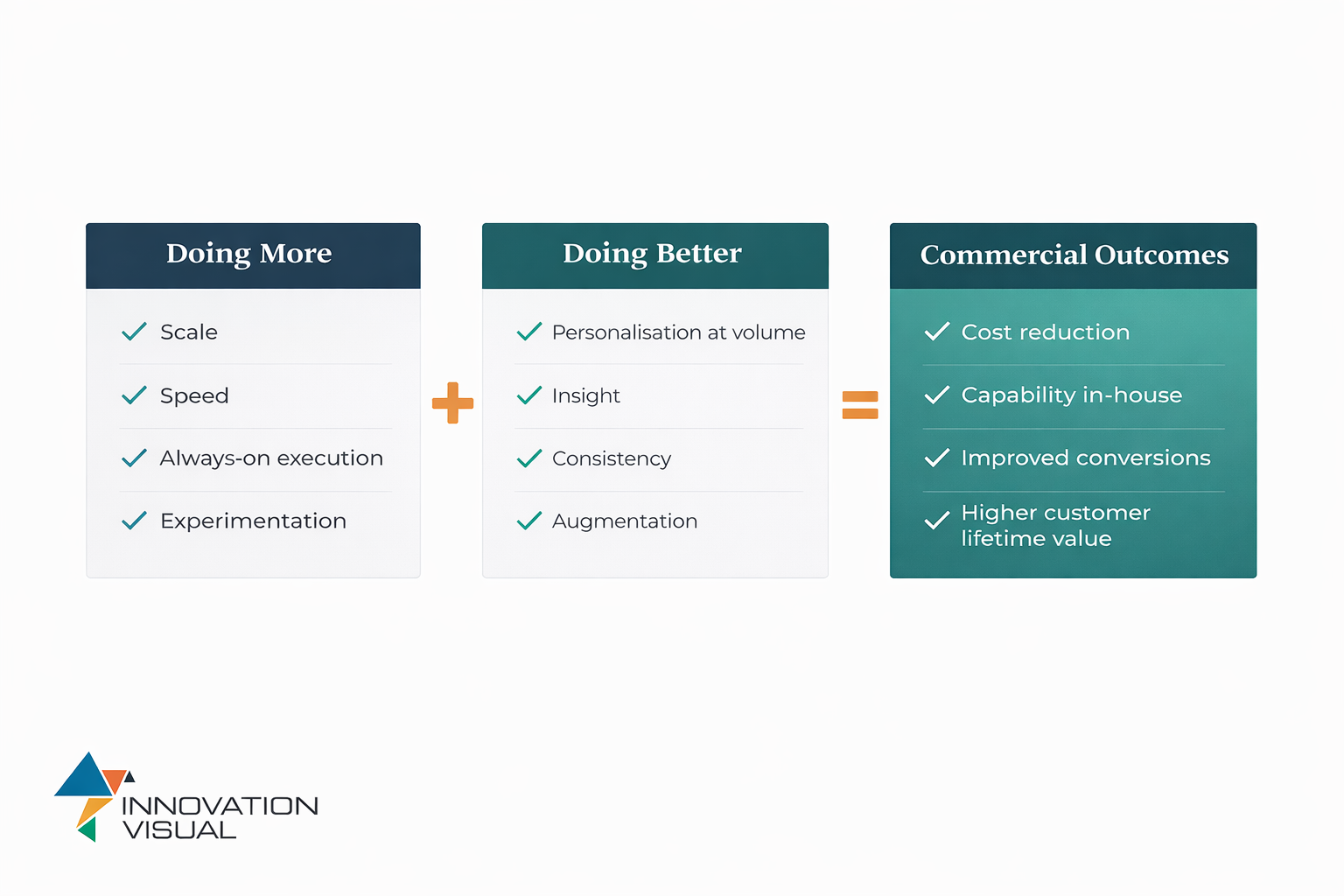
When you combine doing more and doing better, the commercial outcomes begin to compound in ways that are difficult to achieve through any other means:
- The cost of execution falls
- Conversion rates improve because the right message reaches the right person at the right time
- Customer lifetime value increases because the post-sale experience is as intelligently designed as the pre-sale one
That compounding effect is what separates teams operating at the early stages of AI adoption from those running AI workflows and AI agents with genuine autonomy, and it only happens when AI is mapped to the functions where both dimensions can be activated together.
Mapping AI Across Your Marketing Functions
Not every marketing function benefits equally from AI investment, and not every function is ready for it at the same time. Below is how I would categorise investments based on where the evidence from real client engagement is strongest.
Lead Acquisition and CRM Enrichment
For most B2B marketing teams, lead acquisition and CRM enrichment is where AI investment returns the fastest. Enrichment tools can draw from web sources, behavioural signals, and engagement history to fill the gaps in your contact and company data automatically, building a richer picture of who each contact is without anyone needing to update a record manually.
HubSpot's Data Agent Smart Properties, for example, can be configured to extract structured insight from emails, call transcripts, meeting notes, and other activity data and write it directly to the relevant contact properties. Sentiment analysis, engagement scoring, and objection tracking can all be derived from existing interactions rather than inferred by someone reviewing records at the end of the week.
If your CRM data is limited, inconsistent, or dependent on your team remembering to log things accurately, this is where AI investment begins to pay for itself.
Lead Response and Follow-Up
Lead response is where AI's ability to interpret signals and identify the right moment to act creates its most commercially urgent value. Research consistently shows that speed of response is one of the strongest predictors of conversion in B2B sales, and yet most marketing operations are still dependent on a human being opening their inbox before a new lead receives a meaningful reply.
AI agents, as distinct from AI assistants, can be configured to trigger a research and response sequence the moment a form is submitted, capturing the submission, enriching the CRM record with company and contact data, generating a personalised outreach email based on what has been found, and creating an engagement record automatically. That is a deterministic agent running a defined process, and it produces hyper-personalised, context-aware communication at speed, without reading like it was written by a bot.
AI Assistants Vs AI Agents - Chris' Talk from Our Leaders Learning Event
Content Production and Repurposing
Most teams start with this, which is understandable; however, it doesn't necessarily deliver the most return.
AI is extremely useful for content at scale. In the workshops we run, we share the ROSETTA prompting framework to help teams get consistent output: defining the Role the model should take, the Objective of the task, the Specifics of the brief, relevant Examples, the Thinking steps it should follow, the Tools and context available to it, and the Action required.
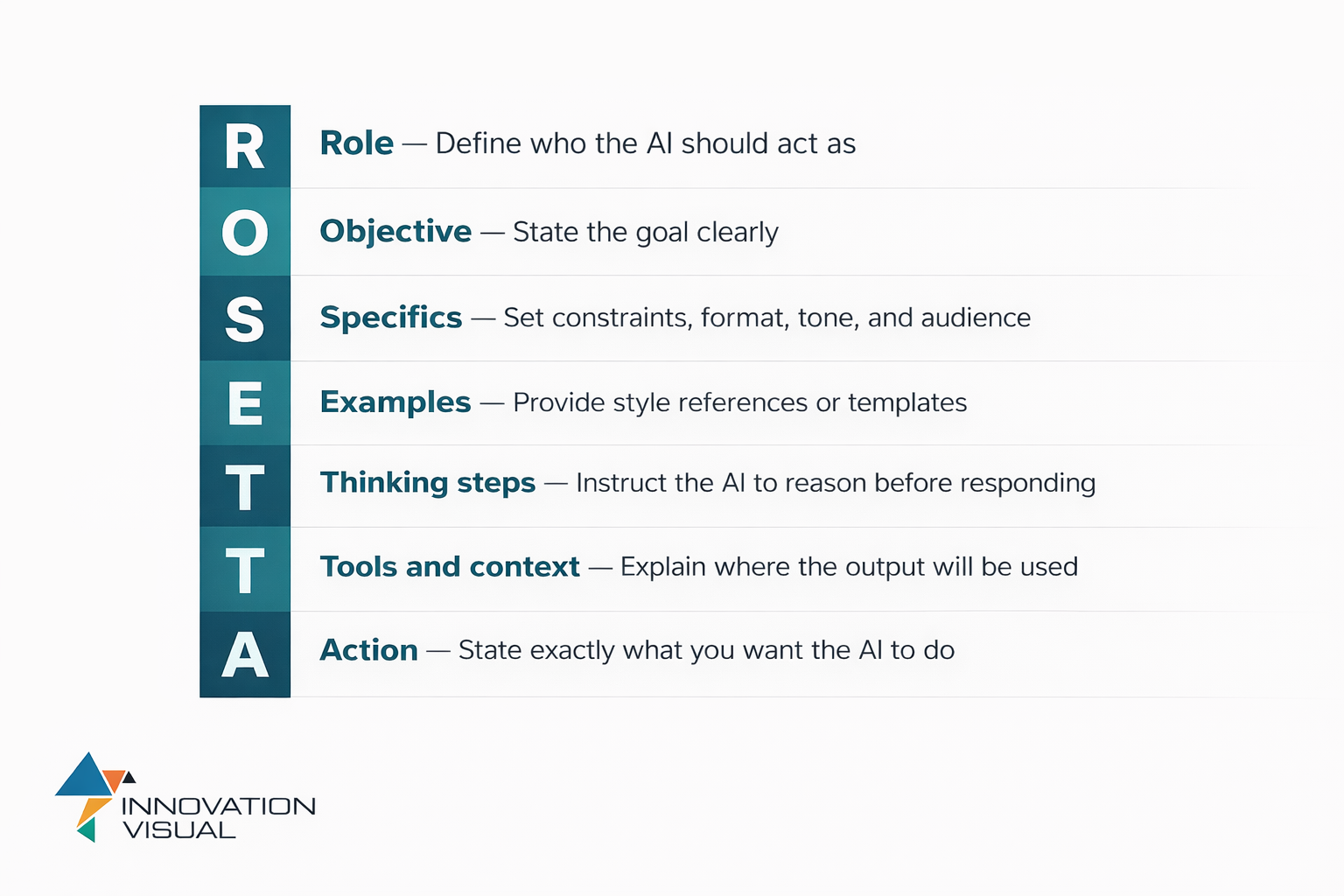
This gives teams a structured way to extract consistent, on-brand output from any model. The real value, though, is in building custom assistants with your brand guidelines, audience definitions, and tone of voice embedded in the system prompt, so that everyone producing content is working from the same foundation rather than reinventing the brief with every new prompt.
Customer Insight and Retention
AI can process unstructured data at scale, and the opportunity this creates is often underestimated.
Call transcripts, email threads, support tickets, and customer feedback contain an enormous amount of signals about why customers stay, why they leave, what they value most, and what they are likely to need next. AI can process that data at a volume and speed no analyst could match, and it can write structured insight directly into CRM properties that then feed personalisation, lead scoring, and retention workflows.
Most B2B marketing teams are sitting on years of this data and doing almost nothing with it, which represents a significant missed opportunity relative to what a well-configured AI layer could surface.
Reporting and Attribution
AI can increase efficiencies in this area, but I would urge caution before prioritising it. The quality of AI-generated reporting is entirely dependent on the quality and completeness of the data feeding it, so if your attribution model is already producing an unreliable picture, AI will not fix it. It will produce faster, more confident-looking versions of the same incorrect picture. Get the underlying data right before asking AI to interpret it.
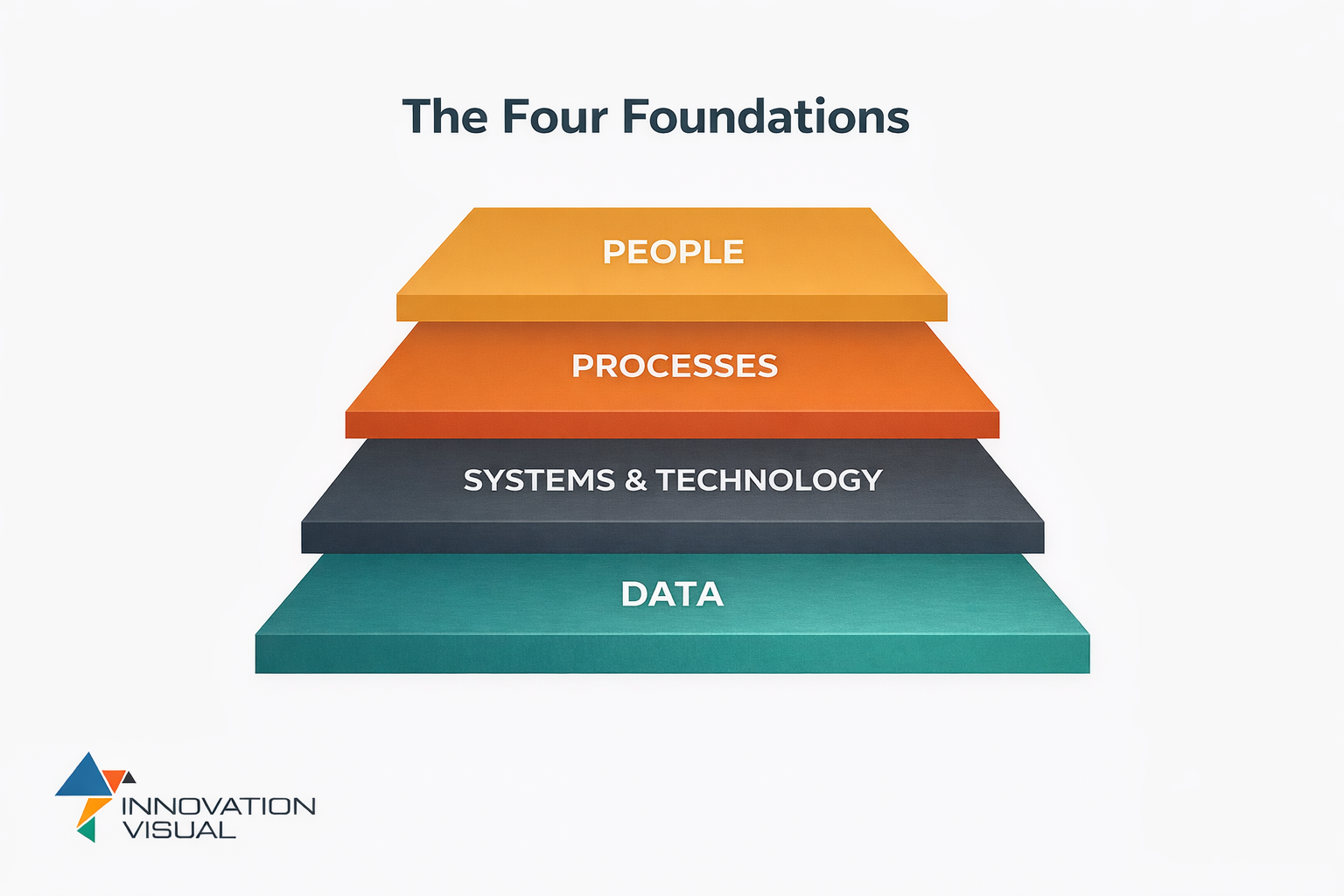
The 4 Foundations That Must Come First
Before any of this works at the function level, the underlying foundations need to be honest.
- People - access to AI tools is not the same as knowing how to use them well. Teams need clear guidance on what AI should and should not be used for, and who is responsible for reviewing its output.
- Processes - AI cannot reliably automate what has not been documented. If a workflow exists only in someone's head, it cannot be handed to an agent.
- Systems and technology - AI works across your stack. If your tools are siloed and not sharing data, AI will hit the same walls your team does.
- Data - clean, connected CRM data with someone within the team owning it. This is the foundation everything else depends on, and the one most teams underestimate until they are mid-implementation.
Read Tim's piece on why AI projects fail, which covers those foundations in detail: What to Do If You Want Your AI Project to Fail: A Leader's Guide
Where to Start: A Practical Prioritisation Logic
-
Lead acquisition and lead response, the WHO and the WHEN, should be the first area of focused AI investment for most B2B marketing teams. Enriching your CRM so that every contact record reflects who that person is and then responding to intent signals faster and more personally than your competitors, are changes that are measurable within weeks, compound over time, and build the data infrastructure that every subsequent AI use case depends on.
-
Content and repurposing come next, because once your data foundation is stronger, the content your AI produces is more targeted and more effective. Asking AI to personalise at scale before your CRM data is clean is asking it to personalise with guesswork. The teams that start with content and treat the data work as something to address later tend to find that later never quite arrives, and twelve months in they are producing more content with the same conversion problem they started with.
-
Customer insight and retention is the one with the longest compounding effect on revenue. It is also the area most teams deprioritise because the commercial impact feels less immediate, even though it directly determines lifetime value and the quality of every acquisition decision you make downstream.
Working With Someone Who Has Done This Before
Knowing the framework is one thing; applying it accurately to your own tools, team, and data is another.
If you have attended one of our Using AI Strategically in Marketing workshops, you have worked through some of this thinking in the room and left with frameworks you can begin applying immediately.
The next step for most leaders is taking that thinking and applying it to their specific marketing function, with the benefit of someone who has mapped these use cases across real client engagement and can tell you, based on what you have in place today, where AI will work and where the foundations need to be strengthened first.
That is exactly what our AI Opportunities Audit is designed to do. It is an expert-led review of your current marketing function, data infrastructure, and technology stack, producing a prioritised roadmap of where AI should sit and in what sequence. For leaders who want a clear view before committing to a course of action, it is the most efficient starting point available, and it removes the guesswork from a decision that has significant downstream implications.
Using AI Strategically in Marketing Workshops
If you are ready to go deeper on the strategic and practical application, and are looking for frameworks, prompting structures, and agent architectures you can begin implementing immediately, the Using AI Strategically in Marketing course runs as a half-day course designed specifically for marketing leaders.
You can sign up here: Book Now
AI Workshop for Leaders
For senior leaders who want to understand the organisational and commercial implications before committing their teams to a programme of change, the AI Workshop for Leaders covers the strategic framing, the maturity model, and the decisions that need to happen at leadership level before AI adoption can scale properly across a business.

Whichever stage you are at, the most important thing is that the thinking comes before the tools. Get that order right, and the investment will follow. Get it wrong, and you will find yourself 12 months from now, wondering why the tools you invested in are not delivering what they promised.