

When leaders are selecting their first AI use cases, there is one principle that matters more than almost anything else.
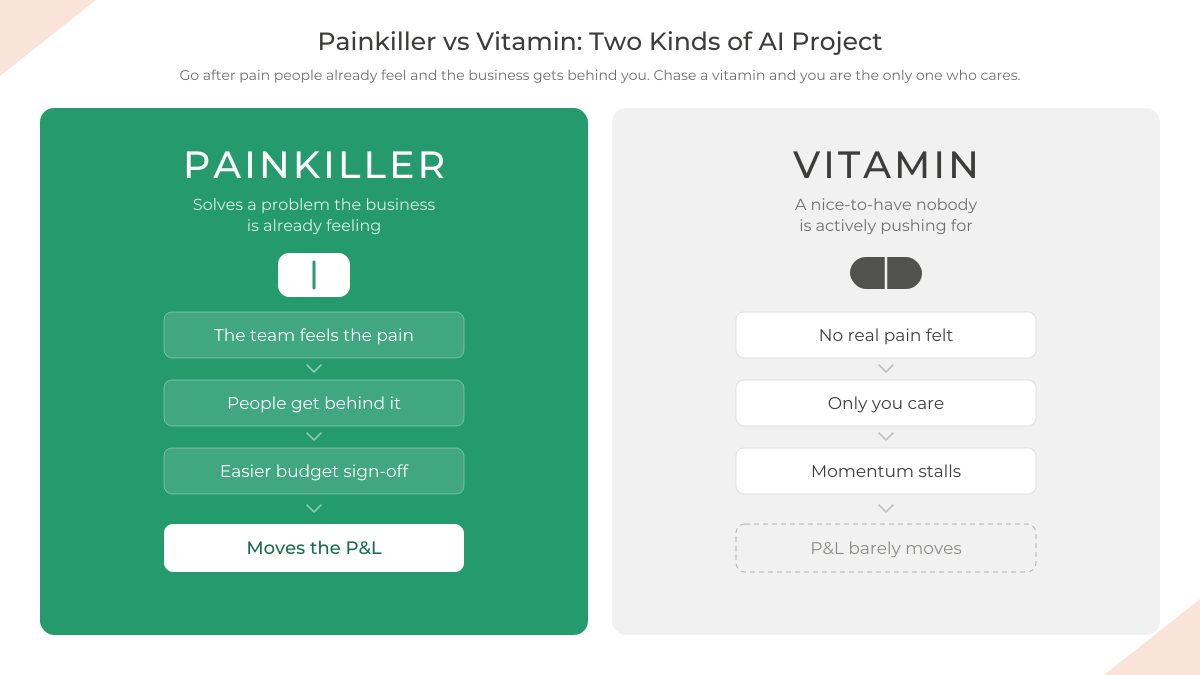
It is better to be the painkiller than the vitamin.
The projects that pay back are the ones that go after real pain in the business, and the projects that fail are the ones that were nice to do but that nobody really needed.
The distinction is not about whether the work could be improved. Almost any process can be optimised. The question is whether the people doing the work feel the pain. A project that aims to make something a bit prettier, or shave 5% off the time it takes, is a vitamin. A project that takes away time-consuming, error-prone, frustrating work that the team hates doing is a painkiller. Those are the projects that get organisational buy-in, because the people involved already know there is a problem and they are ready for someone to fix it.
Go after a vitamin and you will be the only person in the business who cares whether it works. Go after a painkiller and the people whose problem it solves are willing it to succeed, because it is taking away something that genuinely hurts.
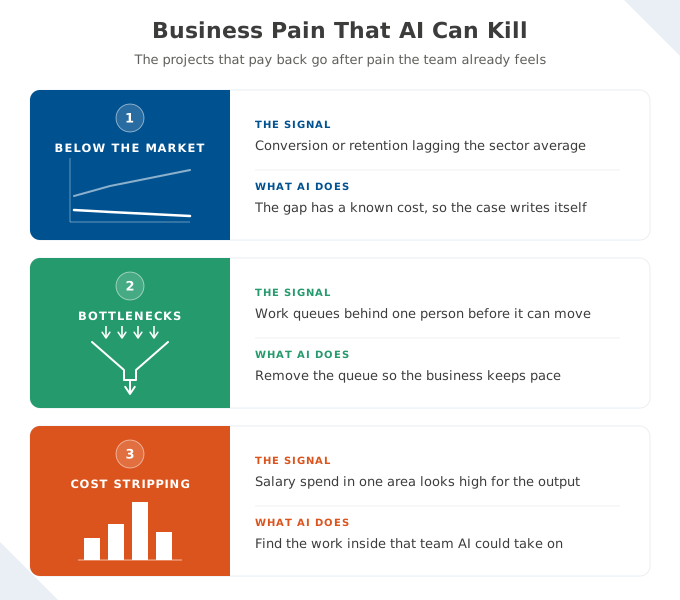
Where to Find the Pain Within Your Business
You Are Behind Competitors or Below Your Sector’s Average
If your conversion rate is half what it should be, or your retention is lagging the market, that is pain. You know what the gap costs and you know what closing it would be worth, so the case for AI writes itself.
Organisational Bottlenecks
Every growing business has at least one role where everything queues up waiting for a decision. We worked with a manufacturer recently where every custom order had to go through their operations director before it could move into production. The business was turning away custom work because they could not get through it fast enough. AI's job there is to remove the queue so the rest of the business can move at the pace the market is asking it to.
Cost Stripping (Where the Salaries Are Going)
If you are the CEO and you look across the whole business, there will be areas where the cost of getting the work done feels heavier than the output justifies. A lot of effort going into sales admin, or into a particular operational function, more than feels right for what it produces. The way through is to find where that effort sits, look at the processes inside that team, and work out which of those processes AI could take on. The aim is to be honest about where the time goes and to free your team from the work that does not need a person doing it, so they can spend their time on the work that does. Done well, it gives you capacity back rather than taking headcount away.
How AI Can Drive Revenue Growth
Once you have located the pain, here’s where AI can start driving revenue growth.
Incrementally Improve Every Step of the Customer Journey
Take a basic journey of finding people in your target market, converting them on the website, getting them to a demo, then to proposal, then to close. If you improve each of those steps by 10%, the gains accumulate to something much larger than any one step alone.
Small improvements across the funnel can deliver significant revenue growth without needing a transformational project.
Attack One Area Aggressively
If you know you are quite poor at getting from demo to close, say you are running at 15% and you should be doing much better, point AI hard at that one transition. Single-point optimisation works when you have a clear weakness and the rest is in reasonable shape.
Reinvent the Game
The virtual retail try-on tools that let customers take a photo of themselves and try clothes on are a good example. Rather than buying from pictures of models, customers are interacting with the products in a way that was not possible before. AI is changing what the process is, rather than making the existing process faster.
Clone your Best People Within the Business
Your best salespeople, your best account managers, your best technical specialists.
Think about:
- How could you be amplifying them?
- How could you multiply them out across the business?
- What do they do that the rest of the team does not, and can AI help the rest of the team do more of that?
The Effort vs Impact Matrix
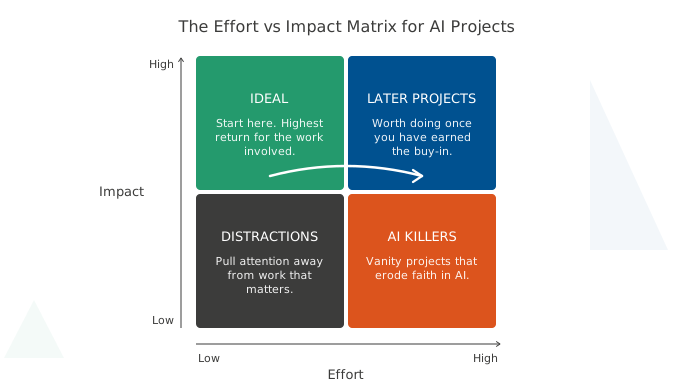
The way to think about which projects to pick first is through an effort versus impact matrix. The ideal projects sit in the high-impact, low-effort quadrant. They are worth chasing because the return relative to the work involved is the best on offer.
High Effort, Low Impact: The AI Killer
They are usually vanity projects, big coordinated efforts involving multiple teams, lots of time, lots of budget, and a relatively small return at the end. People sink the work in, the project supposedly delivers, and then when someone asks about ROI, the answer is not very impressive. The result is the organisation losing faith in AI, which is harder to recover from than not having tried at all.
Low Effort, Low Impact: Distractions
The temptation is to do these because they look like progress, but they take attention away from work that would improve revenue. Leaders only have so much focus to give, and so do the teams below them.
Low-effort, low-impact projects can have a role where they help a team get used to AI and build adoption, particularly where the work can be delegated. But leaders should focus their attention on them, and they are no substitute for finding the higher-impact work.
High Effort, High Impact: Later Projects
They are worth doing, but they need organisational buy-in first. If you go for one of these before the business has seen return from AI work elsewhere, the budget approvals get harder, the sceptics dig in, and the project struggles to get over the line.
Benchmark Before You Build the Case
When you are putting together the business case for an AI project, do not start with AI for the sake of AI. Start with an unambiguous goal for what you want the AI to achieve in that situation, then benchmark properly.
Most teams are not sure how much time and money is currently being spent on the work AI is going to take on. Doing a proper time-and-motion study before the project starts gives you the baseline you need to justify the investment. Just as importantly, it gives you the metrics you will need later when asking for your next project funding. If you do not capture benchmarks at the start, you will struggle to evidence the improvement at the end, and that makes the funding conversation for the next project a lot harder.
Benchmarking Exercise Example
We were running a benchmarking and estimation exercise for a prospect, modelling what would happen if we put an agent in place to take over a process their team was doing manually. We expected the headline number to be the time saving, and the time saving alone would have paid for the tool comfortably. What surprised us, once we had done the work properly, was the downstream impact on conversion. They were paying a certain cost per lead, and even a 10% improvement on the conversion rate produced a revenue gain much larger than the time saving. The case for the project went from being about efficiency to being about revenue, and the numbers behind it became much more compelling.
What To Learn from This
You need to build the business case conservatively. If your case promises a 95% time saving and the project lands at 60%, the next AI project will be much harder to get approved. If your case promises 50% and the project lands at 95%, you have credibility for whatever comes next.
Over-delivering on early projects buys you the room to get sign off for the bigger ones later.
Where to Start
-
Pick the project that addresses real pain in the business.
-
Make sure it is big enough to matter; benchmark it properly before you start.
-
Build the case conservatively so the result is believable.
If you do that, the people in the business will be behind you, the numbers will move, and the next project will be easier to get approved.
Want To Find Your Pain?
The AI Workshop for Leaders is a full day for senior leaders working out where AI fits in their business and where it does not. We work through your real processes, the pain points where AI would make a measurable commercial difference, and the projects worth approving first. You will leave with a clear view of where to start, where to wait, and what to walk away from, and you can begin implementing the day you are back in the office.
If you would rather have a direct conversation about the business problems you’re facing, you can book some time with me using my meeting link.
Frequently Asked Questions
These are the questions that come up most often when leaders are working out where to start with AI.
How do you choose your first AI project?
Choose the project that addresses real pain in the business rather than one that is nice to have. The strongest first projects sit in one of three places:
-
Where you are below your competitors or below the sector average.
-
Where there is a bottleneck holding the business back.
-
Where the salary spend feels disproportionate and the processes inside that team could be partly handled by AI.
What is the difference between a painkiller and a vitamin AI project?
A painkiller AI project solves a problem the business is already feeling. A vitamin AI project is a nice-to-have that might help over time but that nobody is particularly pushing for. Painkillers get organisational buy-in because the people involved already know there is a problem. Vitamins struggle to build momentum because nobody was bothered enough by the underlying issue to begin with.
How do you build the business case for an AI project?
Start with a clear, unambiguous goal for what you want the AI to achieve. Benchmark the current process properly before you start. That means a time-and-motion study on how long it takes today, what it costs, and what the output quality is. Then estimate the likely improvement conservatively.
The benchmarks also matter for the project after this one, because future funding decisions will look back at whether you measured the improvement properly.
How do you measure ROI on an AI project?
Time saved is part of the picture but often not the biggest part. The bigger numbers usually live in the downstream commercial impact, things like conversion rate improvements, quality improvements, or better throughput that translates into revenue. A benchmarking exercise that only measures the direct time saving will often understate the value of a good project significantly.
Should you start with a small AI project to test the idea?
Small projects have a role in helping teams get used to AI and build adoption, particularly where the work can be delegated, but they should not be where a leader spends their own attention. The projects worth a leader's time are the ones that go after real pain in the business and that are big enough to deliver meaningful commercial impact.