

.png?width=772&height=434&name=image-gen%20(1).png)
Why Personalisation Has Become Your Competitive Advantage
When did you last abandon a website because it showed you irrelevant content?
Personalisation in marketing has shifted from a nice-to-have differentiator to a business-critical strategy.
According to a study by Qualtrics XM Institute, 64% of consumers globally prefer to buy from brands that deliver personalised interactions, tailoring their experience to their wants and needs.
The revenue implications are stark. Businesses that personalise effectively generate up to 40% more revenue than those relying on generic campaigns.
What's changed since 2024?
We’ve written about personalisation before, so what’s changed? The acceleration of AI and automation has made sophisticated personalisation accessible to mid-sized businesses, not just enterprise giants with deep pockets. The tools have matured, the data infrastructure has simplified, and the learning curve has shortened.
This guide shows you exactly how to capitalise on personalisation trends without overwhelming your team.
Trend #1: Website Personalisation as Your Silent Sales Team
Your website can do far more than display information. It can actively qualify and nurture visitors based on who they are and what they need. Dynamic content that adapts to visitor behaviour, industry, company size, or lifecycle stage transforms a static site into an always-on sales asset.
HubSpot's analysis of over 330,000 CTAs found that personalised calls-to-action convert 202% better than generic versions. Smart CTAs that adapt based on previous interactions mean returning customers see relevant upsell opportunities, whilst first-time visitors receive appropriate introductory content. This means shorter sales cycles, reduced bounce rates, and self-service pathways that qualify leads ready for your sales team to pick up and close deals.
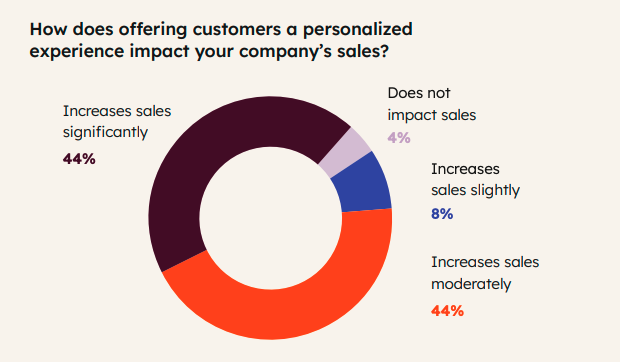
HubSpot's State of Marketing Report
In a survey from HubSpot’s State of Marketing Report 2025, 96% of marketers reported that personalised experiences have increased sales.
Discover how website transformation can turn your site into a conversion engine.
Trend #2: Segmentation and Email Personalisation That Drives Revenue
The days of batch-and-blast email marketing are over. Today's high-performing campaigns are built on behavioural and predictive segmentation, delivering different messages to different stages of the customer lifecycle based on purchase history, browsing behaviour, and real-time actions.
As a result, marketers using segmented campaigns have noted as much as a 760% increase in revenue compared to generic broadcasts. HubSpot's State of Marketing Report confirms that segmented emails drive 30% more opens and 50% more click-throughs than unsegmented ones.
At Innovation Visual, we saw this first-hand when we implemented preference-based segmentation for Joseph's Wigs. Their general newsletter achieved a 29% open rate and a 28% click-through rate. However, segmented newsletter emails tailored to specific customer needs achieved a 63% open rate and a 51% click-through rate, resulting in a 170% year-on-year revenue increase.
Find out more about our Personalised Marketing strategies
Trend #3: AI-Powered Personalisation at Scale
For years, marketers faced an impossible choice: personalise deeply for a handful of accounts or reach thousands with generic messaging. With data-driven AI, that trade-off no longer exists. Tools like AI segmentation, AI-generated email and page variations, and automated behavioural targeting now allow us to personalise at scale. Instead of just relying on one-off manual rules, AI continuously adapts content and messaging across your database, ensuring every contact receives a more relevant, tailored experience.
In 2025, 79% of marketers now cite increased efficiency as their primary benefit from AI adoption. This efficiency gain translates directly into personalisation capability. Teams can now deliver customised experiences across their entire database without proportionally increasing headcount.
Top Benefits to Adopting AI
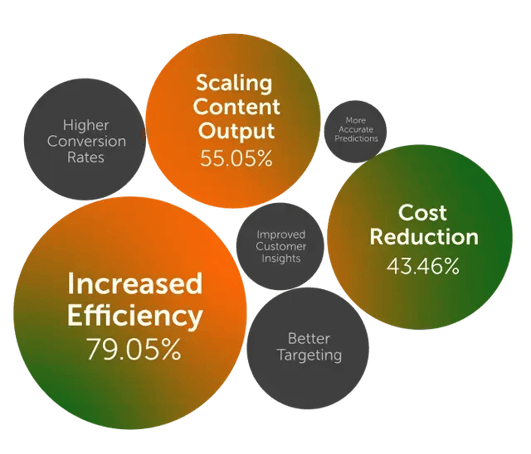
CoSchedule's 2025 State of AI in Marketing report
The shift from reactive to predictive marketing represents perhaps the most significant change. Modern AI tools analyse behaviour patterns to anticipate what prospects need before they explicitly express it, moving personalisation from "responding to signals" to "anticipating intent."
Platforms like HubSpot's Content Hub enable more personalisation, offering features like Content Remix that automatically repurpose content across formats whilst maintaining brand voice.
However, this technology works best when built on clean, structured data, and when human oversight ensures authentic, relevant outputs.
Trend #4: Unified Personalisation Across Marketing and Sales
Personalisation that stops at marketing handoff creates a poor user experience. When a prospect receives beautifully customised content from marketing, then generic outreach from sales, the disconnect undermines everything that came before.
The data supporting unified approaches is compelling. According to Adobe, 76% of marketers report that account-based marketing delivers higher ROI than other strategies.
The practical application extends beyond ABM programmes. When sales teams can access marketing engagement data (which emails a prospect opened, which pages they viewed, which content they downloaded), their outreach becomes infinitely more relevant. Alternatively, when marketing can see which objections sales encounters repeatedly, they can create content that addresses concerns before they arise.
A unified CRM becomes the foundation for this approach, providing what HubSpot describes as a "single source of truth" that connects every customer interaction.
Watch our podcast episode on 'How AI Can Enable Personalisation Through Emotional Understanding'
Getting Started: Your Personalisation Roadmap
Personalisation can feel overwhelming when you consider every possible application simultaneously. The most successful implementations start small, prove value quickly, and expand in phases:
Phase 1: Foundation (Months 1-2)
Begin with an honest assessment of your data. Audit what you're collecting, where gaps exist, and how consistently information flows into your CRM. Define your key customer segments, not dozens, but the three to five that matter most. Then identify quick wins: personalised email subject lines and basic smart content on key website pages require minimal setup but demonstrate immediate impact.
Phase 2: Expansion (Months 3-6)
With foundations established, implement behavioural triggers that respond to prospect actions. Deploy smart CTAs across your website and begin systematic A/B testing, personalised versus generic, to build internal confidence with measurable results.
This phase is about proving the business case whilst refining your approach.
Phase 3: Sophistication (Months 6-12)
Now layer in AI-powered recommendations and develop account-based personalisation strategies for high-value prospects. Create connected customer journeys spanning multiple touchpoints, and critically, integrate your sales team's outreach with marketing's personalisation efforts to deliver consistency throughout the entire buyer experience.
The key is momentum. Start where you'll see results fastest, then build from proven success.
Common Personalisation Pitfalls (And How to Avoid Them)
Even well-intentioned personalisation efforts can backfire. Here are the mistakes we see most frequently:
- Over-personalisation makes prospects uncomfortable. Referencing data, they didn't knowingly share, or being too specific too early, triggers the unsettling "how did they know that?" response that damages trust.
- Under-personalisation wastes your investment. Using someone's first name whilst ignoring everything else you know about them barely qualifies as personalisation.
- Technology before strategy leads to expensive shelfware. Purchasing sophisticated tools without a clear plan for implementation leaves capabilities unused and budgets strained.
- Poor data quality undermines everything. Personalisation built on outdated, incomplete, or inaccurate data creates embarrassing mistakes that take away credibility.
- Failing to test means flying blind. Without systematic comparison of personalised versus generic approaches, you cannot prove value or identify what resonates.
- Siloed personalisation fragments experiences. When marketing, sales, and service teams personalise independently, customers receive inconsistent communications.
The antidote to each: start with strategy, maintain data discipline, and coordinate across teams.
Measuring Success: The Metrics That Matter
Personalisation without measurement is just guesswork. Structure your reporting across four categories:
- Engagement metrics reveal whether personalised content resonates: open rates, click-through rates, time on site, and pages per session all indicate relevance.
- Conversion metrics show business impact: form completions, demo requests, and purchases demonstrate that engagement translates into action.
- Revenue metrics quantify value: average order value, customer lifetime value, and influenced revenue per channel connect personalisation directly to commercial outcomes.
- Efficiency metrics prove operational gains: marketing-qualified lead volume, sales cycle length, and cost per acquisition reveal whether you're working smarter.
Always measure personalised experiences against non-personalised alternatives; this isolates the true impact of your efforts and builds evidence for continued investment.
Establish benchmarks before implementation, then track improvement over time. And whilst conversion metrics capture immediate wins, customer retention remains the ultimate measure of personalisation done well.
Personalisation as a Revenue Driver, Not Just a Marketing Tactic
Personalisation is no longer optional; it's a requirement.
However, sophistication levels vary dramatically, and the competitive advantage belongs to businesses that implement thoughtfully and measure rigorously.
Mid-sized organisations are particularly well-positioned. You're large enough to benefit from automation and AI, yet agile enough to implement quickly without enterprise bureaucracy slowing progress.
The connection to revenue is direct: better conversion rates, improved retention, and increased customer lifetime value. This isn't marketing theory - it's measurable commercial impact.