
As AI tools mature and budgets remain tight, 2026 demands execution over experimentation. Working daily with clients across technology, digital marketing, web development including AI implementation, we've identified seven critical trends that will define marketing success this year.
Prediction 1: Data Quality Will Become a Strategic Imperative
Throughout 2025, one issue stood out above all others: messy, inconsistent data across organisations. Vanessa Reid, our MarTech Manager, puts it bluntly: "What really stood out was the prevalence of messy, inconsistent data across many companies new to working with us. We saw significant gaps in data, disconnected systems and unclear ownership of information. Without a strong foundation of solid, well-structured data, teams struggled to get meaningful insights, trust their reporting or fully leverage automation and AI tools."
This created a cascade of problems: brittle automation, unreliable AI outputs, and duplicated effort across teams. It reinforced an important truth: you cannot build intelligent systems on broken foundations.
Particularly among teams using HubSpot, there's been a growing focus on data quality. Businesses are realising that automation, personalisation, reporting, and targeting, only work when the underlying data is clean, reliable, and up to date.
Furthermore, HubSpot decided this year to make data enrichment free for all paid plans. This has accelerated this shift, giving organisations an accessible entry point to fill gaps and standardise information, so they're able to personalise and automate their marketing campaigns.
Throughout 2025, we helped our clients establish clean data foundations, standardising lifecycle stages, establishing clear ownership, and implementing automated data-cleaning workflows. This positions them to confidently scale AI and automation in 2026. For organisations just beginning this journey, getting your data in order is the critical first step before any meaningful AI investment. An AI opportunities audit can help you build a clear strategy and actionable next steps, so your AI investments deliver.

Discover our data hygiene services for AI readiness
Prediction 2: AI Will Move from Experimentation to Core Operations
With data foundations addressed, the next trend is how organisations actually deploy AI. 2025 was the year most sales and marketing teams "tried" AI. According to research, many businesses launched AI powered chatbots, generated content, and added automation onto already-fragile systems. The results were mixed. Research shows that while 74% of organisations report achieving ROI on AI within the first year, most take 2-4 years to see satisfactory returns, and 70-85% of unfocused AI initiatives still fail to meet expected outcomes. However, we are seeing focused AI implementations achieving positive returns in just months.
The key trend emerging is the implementation of AI within core operations across organisations‚ moving away from individuals using AI tools, and instead deploying deterministic agents working in the background to make operations more streamlined, efficient, effective, and scalable.
Rather than relying on a single AI tool, businesses will increasingly deploy collections of specialised AI agents that work together across different systems to achieve complex goals. These multi-agent systems enable more advanced automation of end-to-end processes, such as data management and customer engagement.
This translates directly to commercial outcomes. We expect to see far more organisations confidently grasping AI and applying it effectively. AI agents will move from experimentation into everyday use, supporting lead qualification, forecasting, customer support, and internal enablement.
Grand View Research indicate that the AI agent market is expected to grow at a CAGR (Compound Annual Growth Rate) of 45.8% from 2026 to 2030. In this scenario, the market size could grow to over $100 billion (USD) by 2032. This highlights just how quickly organisations will want to implement the technology and why your organisation cannot get left behind.
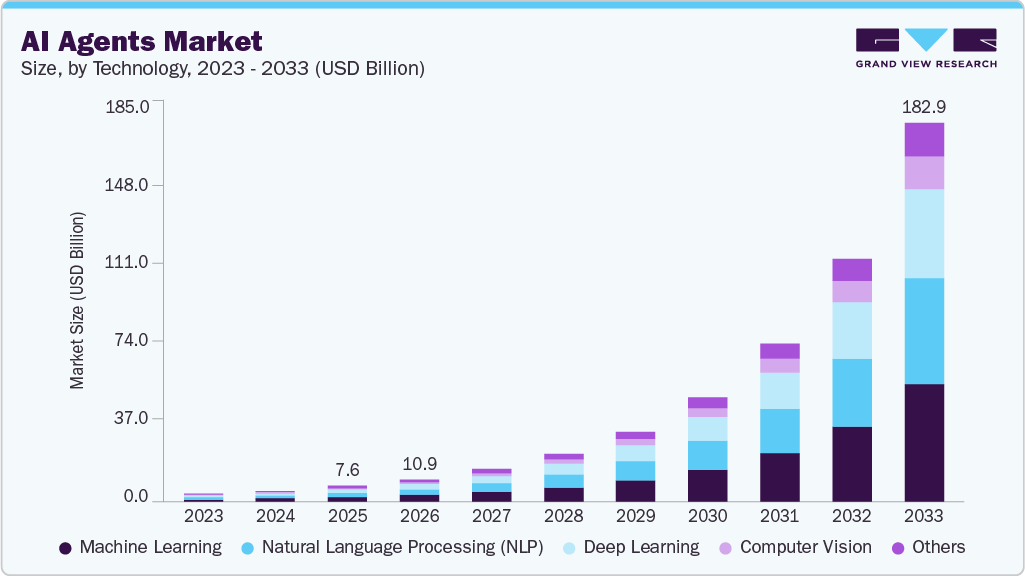
Source: Grand View Research
Prediction 3: AI Agents Will Reshape Customer Journeys
This push towards AI agents is reshaping customer journeys. According to Gartner's 2026 predictions, by 2028, 60% of brands will use agentic AI to facilitate streamlined one-to-one interactions, collapsing channel-technology architectures and redefining customer journeys.
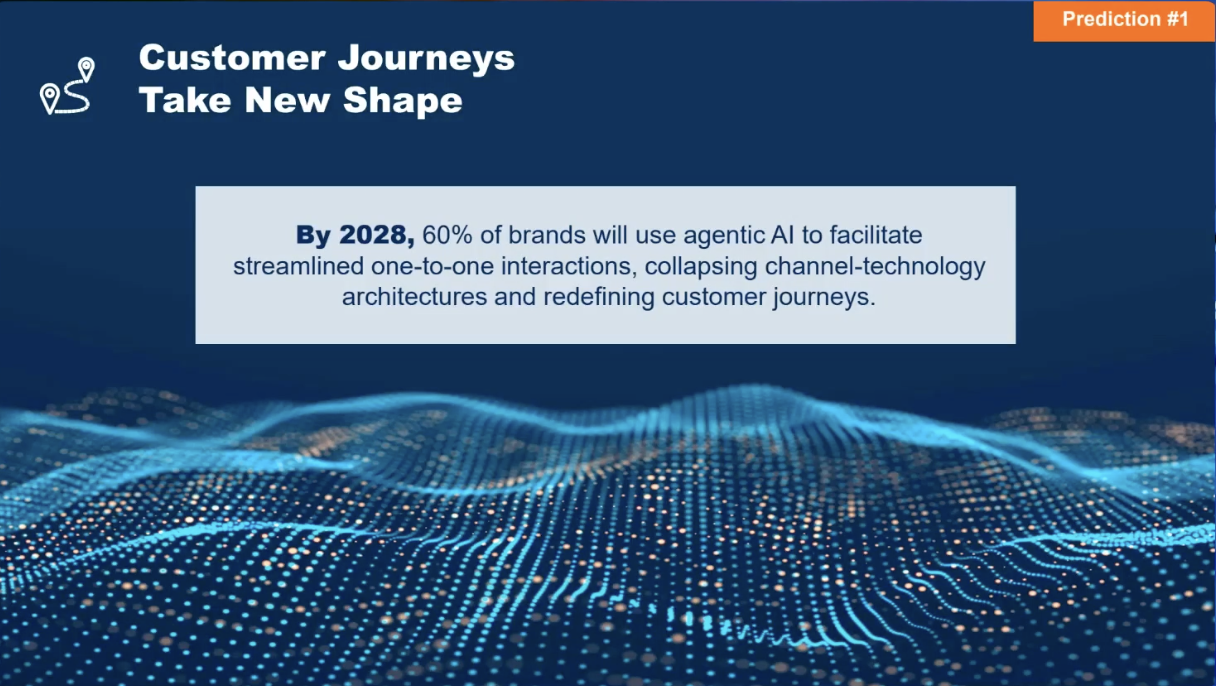
Source: Gartner
This transformation means AI agents won't just optimise experiences, they'll own them. Taking proactive actions based on interactions and acting as personalised helpers for customers. This requires organisations to prepare for personalisation at unprecedented scale, which circles back to data governance as the foundation. Businesses will need to track customer journey changes and account for the total cost of ownership of each agent.
Perhaps most critically, this change requires upskilling teams. Leaders must focus on the "what" and "why" rather than the "how" that AI increasingly handles.
We're helping organisations navigate this shift through our AI Workshops, working with leadership teams to identify high-impact use cases, build implementation roadmaps, and upskill teams for the AI-first era. Book your place on one of our AI workshops.
Prediction 4: Traffic Will No Longer Be a Success Metric
One of the most counterintuitive trends of 2025 was declining website traffic paired with improved conversion rates. As AI Overviews and zero-click search results expanded, organic sessions fell; yet lead quality often improved.
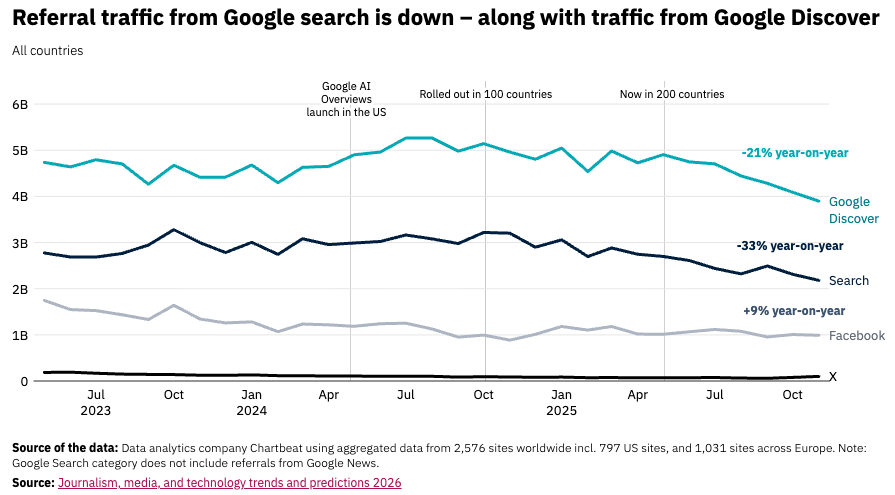
Source: Reuters Institute
Kate Staples, from our Client Services team, spent much of 2025 navigating this with clients: "Several clients worried that fewer recorded sessions would deliver poorer results, but in most cases, conversions and revenue remained increased. Much of my work focused on reassuring clients and shifting conversations from vanity metrics towards meaningful results.”
AI-generated answers are now delivered directly in search results or AI platforms like ChatGPT, which means users no longer need to click and visit websites, fundamentally changing search behaviours.
For 2026, the focus should be on measuring success differently and optimising for AI visibility. Stop tracking traffic as your primary success metric. Instead, focus on:
- AI and search visibility - Are you appearing in AI Overviews, featured snippets, and AI-generated responses?
- Revenue and leads from organic - Track commercial outcomes, not sessions.
- Entity ownership – Is the content you produce focused on what your brand is known for? Do you own rankings for these topics?
- Brand and domain authority – Is your website receiving backlinks and mentions from relevant sources? Is there positive sentiment around your business and products/services?
Your website still needs to be optimised for search but you also need to consider how LLMs (Large Language Models) retrieve content to get cited in AI answers. Your content should follow EEAT guidelines (Experience, Expertise, Authoritativeness, Trustworthiness) and be structured in certain way so LLMs can easily retrieve and understand it.
Prediction 5: Authenticity Will Become a Competitive Differentiator
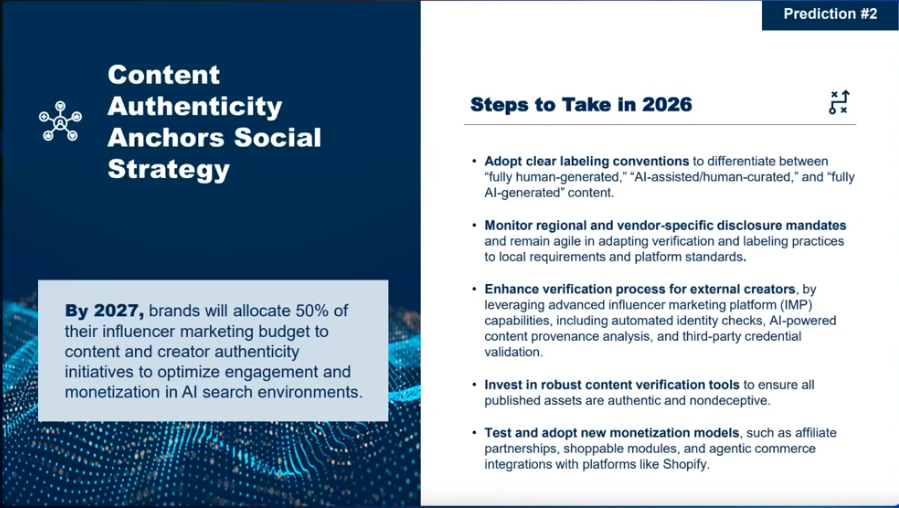
Gartner predicts that by 2027, brands will allocate 50% of their influencer marketing budget to content and creator authenticity initiatives to optimise engagement and monetisation in AI search environments.
Source: Gartner
As AI becomes ubiquitous, people will increasingly crave authentic human connection. Additionally, with social media content now appearing within search results, authenticity verification becomes even more critical.
The brands that will win will be the ones that can choose wisely where to automate as well as where to keep the human touch. They’ll use AI to enhance their content or speed up their process but still include human expertise and curation. They’ll understand where humans bring the value that their audience want and will deliver helpful, entertaining content with more streamlined processes.
Prediction 6: Paid Media Costs Will Rise While Returns Diminish
The data and traffic shifts mentioned previously have direct implications for paid media, where 2025 forced hard decisions.
Performance Max delivered volume, but often at the expense of quality. For several clients, we stopped PMAX entirely, reallocating budget to traditional Search campaigns where control, transparency, and higher intent still exist. Driving improved results. Google Ads pushed AI aggressively to make advertising feel more accessible, but often at the cost of performance and advertiser control.
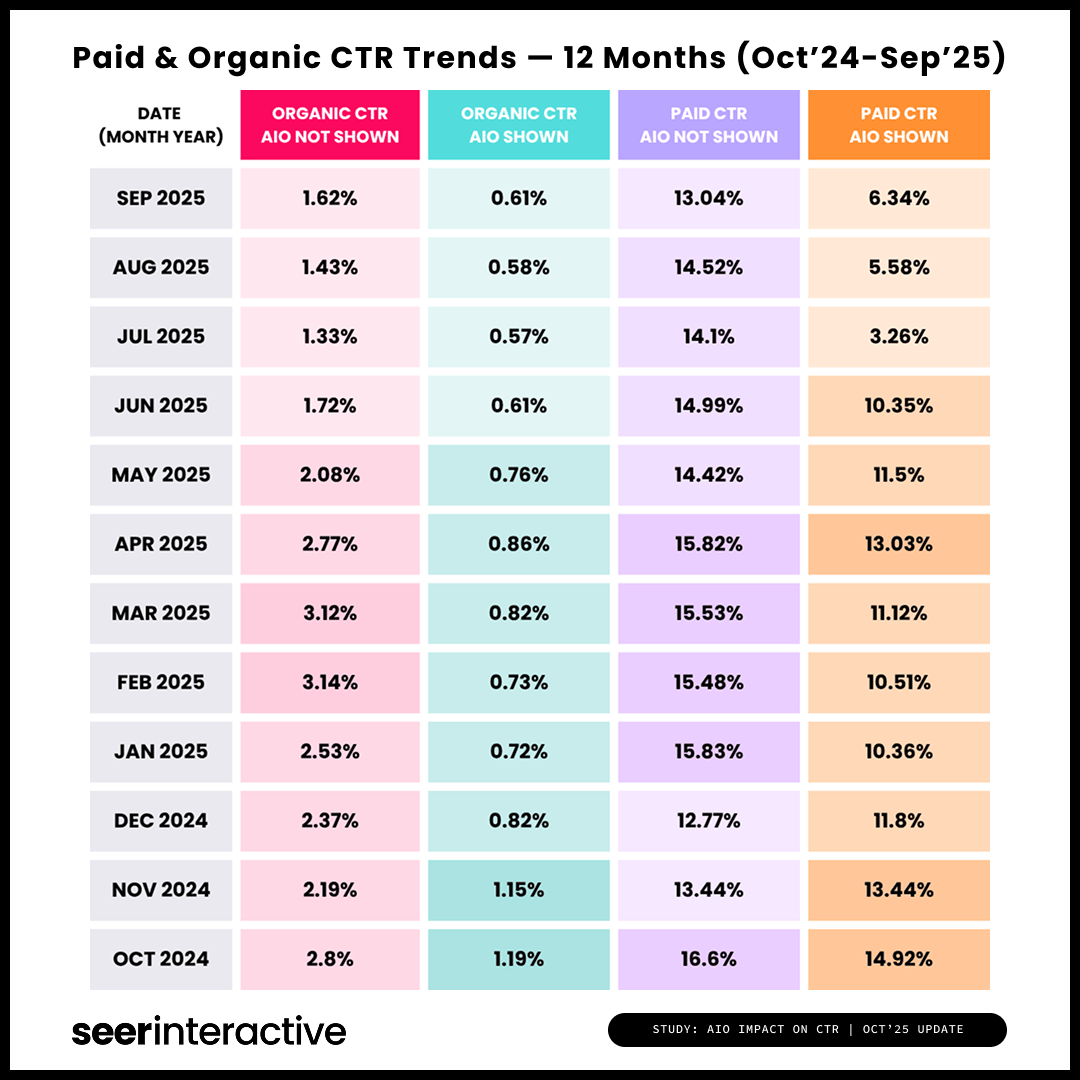
The numbers tell the story. Average CPC across Google Ads rose to $5.26 in 2025, with costs increasing for 87% of industries. AI Overviews devastated click-through rates: organic CTR dropped 61%, paid CTR crashed 68%. Publishers globally saw Google traffic decline by a third, pushing smaller companies toward expensive paid advertising as their only remaining option.
Source: Search Engine Land
This creates a compounding problem. Fewer clicks mean fiercer competition for top positions. AI-generated ad copy makes messaging increasingly generic. The result: rising costs, declining differentiation, and more spend chasing attention with similar ads.
Our advice for 2026: Treat automation as an optimiser, not a strategist. Human judgement remains essential for channel mix and intent management. Review PMAX performance in Q1 and be prepared to shift budget to higher-intent channels if lead quality is suffering. Remember also that those businesses with falling traffic AND falling performance often are forced to turn to paid media to try and compensate. This is leading to even greater competitive pressures in paid media, driving up CPC / CPM and impacting profits available from this channel.
Prediction 7: Doing More with Less is Still on the Table
These market pressures – AI data challenges, AI transitions, traffic shifts, rising media costs – all converge in one place: your team's capacity.
Abbie Garland, from our Client Services team, observed a clear shift: "Client services became more focused on efficiency as client budgets tightened. Teams spent more time prioritising activity, proving value, and responding quickly to client needs, with a stronger emphasis on clear communication and practical delivery."
For the past few years, the theme has been clear: doing more with less. Budgets are expected to remain tight, so your team will need to focus on prioritisation, efficiency, and clearly demonstrating value. Having strong processes in place, using automation where it matters, and staying focused on customer needs will be the difference between winners and losers in this landscape. It also means that moving to an agentic future where smart marketers have hybrid human // agent teams is becoming a necessity to compete.
What Your Organisation Needs to Focus on in 2026
2026 is about organising the mess to reap the rewards of your AI investment!
2026 will see the end of AI experimentation and the beginning of accountable deployment in most businesses. Clean data has moved from nice to have, to strategic imperative. Quality is overtaking volume as the measure of success. Media costs are rising while organic reach declines. And paradoxically, as automation accelerates, authentic human connection becomes the competitive differentiator. These aren't theoretical predictions‚ they're shaped by the realities our consultants navigated throughout 2025, from fixing broken data foundations to rebalancing media strategies and helping leadership teams focus on what actually drives growth.
2026 belongs to marketers who combine intelligent automation, focused agentic deployments with commercial clarity and human authenticity. The experimentation phase is over. It's time to plan, deploy, optimise, and deliver.
Your 2026 Action Plan
Prioritise Data Governance Now
Before investing further in AI or automation, audit your data quality. Establish clear ownership, standardise lifecycle stages, and implement automated data-cleaning workflows. Without this foundation, every technology investment will underdeliver.
Move AI from Pilot to Production
Stop testing AI in isolation. Deploy multi-agent systems that work across your tech stack to deliver end-to-end automation. Focus on high-impact use cases: lead qualification, forecasting, customer support, and content personalisation.
Upskill Your Team for Strategy, Not Execution
AI will increasingly handle the "how." Your team needs to focus on the "what" and "why." Invest in strategic thinking, commercial acumen, and the uniquely human skills that AI cannot replicate. Learn more about our ADAPT process for ensuring your human assets are onboard with increasing AI deployment on our AI training courses for leaders.
Shift Metrics from Vanity to Value
Stop worrying about traffic and impressions. Focus more on tracking pipeline contribution, conversion quality, and commercial impact. Be prepared to defend declining traffic numbers if conversions and revenue are improving.
Audit Your Paid Media for Quality, Not Just Volume
Review automated campaign performance. If lead quality is suffering, reallocate budget to higher-intent channels where you maintain control and transparency.
Build Authenticity into Your Content Strategy
Implement clear labelling for AI-generated vs. human-created content. Invest in verification tools and processes. Focus on user-generated content, genuine expertise, and voice-of-customer insights that AI cannot replicate.
Embrace "Doing More with Less"
Conduct a ruthless prioritisation exercise. What activities directly contribute to client value? What can be automated? What shouldn’t be automated? What should be stopped entirely? Use AI to scale execution while reserving human effort for insight, storytelling, and trust-building. Have you run an AI feasibility studies across your marketing and sales teams yet?
Ready to Turn These Trends into Results?
The gap between knowing what needs to happen and actually executing it has never been wider. Most organisations understand they need better data, smarter AI deployment, and authentic content, but struggle to prioritise, resource, and implement these changes effectively.
That's where we come in. Innovation Visual works with forward thinking marketing, and increasingly sales, teams to translate strategy into execution.