
.png?width=772&height=434&name=BlogCase%20Study%20Images%20(7).png)
When I talk to HR directors and people leaders about AI, I often encounter a version of the same situation. They've usually given their team access to ChatGPT or Microsoft Copilot, they're getting some time savings here and there, and they're wondering why everyone is talking about AI as though it's going to fundamentally transform how organisations operate.
The answer, in most cases, is that they're using AI assistants and they haven't yet encountered AI agents.
This distinction is, I'd argue, the single most important conceptual shift an HR leader can make to properly understand where AI is heading and what it will mean for their function, their team, and their organisation's workforce planning.
The Assistant: AI That Helps You Work
An AI assistant is a tool that helps you complete a task faster or better. You are still in the loop at every stage. You prompt it, it produces something, you review it, you refine it, and you use it. The value is efficiency because tasks that might have taken you 30 minutes take 5. Work that previously required a first draft from scratch gets a good starting point immediately.
In HR, the use cases for this are genuinely valuable and immediately accessible. At Innovation Visual, we work with clients who are using AI assistants for:
- Writing and tailoring rejection emails at scale while maintaining a personalised, professional tone
- Generating structured call summaries from meeting transcription tools such as Fathom or Otter
- Drafting and merging job descriptions, incorporating role requirements and company tone consistently
- Producing interview question banks tailored to specific competencies and seniority levels
- Researching and summarising employment law updates for policy review
These are real, practical productivity gains. They're available now, and they don't require significant technical investment to access. But they are assistants, and they work because you are directing them at every step.
The Agent: AI That Does the Work
An AI agent is something categorically different. Where an assistant helps you complete a task, an agent is given a goal and goes away to complete it. It takes actions, makes decisions, and works through a process autonomously. You set the objective; the agent figures out how to execute it.
“An assistant helps you do your work faster. An agent does the work. That distinction is going to reshape how HR functions think about headcount, process design, and oversight.”
The examples that resonate most clearly for HR audiences tend to be ones that map onto existing, time-consuming processes. Consider an employee onboarding agent. Rather than an HR professional manually chasing each new joiner through a checklist of pre-boarding tasks, an agent can own that entire workflow from sending the relevant documents, chasing for responses, collecting preferences (right down to a T-shirt size), through to escalating when deadlines are missed, and updating the relevant systems throughout. It doesn't forget. It doesn't have a bad morning. It completes the task.
Or consider recruitment at volume. An agent could be configured to monitor a specific internal talent system and, when a new role is created, automatically surface the five strongest internal candidates based on skills, experience, and development trajectory before a single CV has been received externally. This isn’t something for the future; it is technically buildable today.
Other agent deployments we have built or are building for clients include document validation workflows, not just scanning and recording documents, but comparing claims against each other across multiple sources. In one case, we built an agent for a financial services client that validates mortgage application documents by cross-referencing stated salary against payslips, employment letters, and tax documentation simultaneously. The same principle applies to right-to-work checks, qualification verification, and reference validation in an HR context.
Learn more about AI agents as a service.
Autonomous vs Deterministic: The Control Dial
Within the category of agents, there is a further distinction that matters enormously for HR: the spectrum between autonomous and deterministic agents.
.png?width=772&height=483&name=BlogCase%20Study%20Images%20(8).png)
An autonomous agent is given an objective and decides for itself how to pursue it. It will develop its own approaches, adjust its behaviour based on what it observes to be working, and make independent judgements. This is powerful, but in an HR context, it is also risky because those independent judgements may not always align with your legal obligations, your values, or your policies.
A deterministic agent, by contrast, follows a defined process to reach its objective. The logic is structured: if this condition is met, take this action; if that condition is not met, escalate to a human. It operates within guardrails you have explicitly set. Interestingly, Salesforce announced in late 2025 that it was actively making several of its highly autonomous agents more deterministic, having found that fully autonomous agents were starting to behave in ways that were unexpected and commercially problematic.
For HR specifically, I would almost always recommend erring toward the deterministic end of this spectrum, particularly in early deployments. The reason is that HR decisions are high-stakes, frequently have legal dimensions, and require clear audit trails. A deterministic agent gives you those things. An autonomous one does not.
‘Human in the loop’, a phrase you will hear often, is most naturally implemented in a deterministic architecture. At certain defined points in the agent's workflow, it pauses and asks for human review or approval before proceeding. That is the kind of responsible AI deployment that is both legally defensible and practically effective.
What This Means for HR Strategy
The question I put to every HR leader I work with is ‘when you look at your function's work, what proportion of it is highly repeatable, process-driven, and rules-based?’, because that is the work that agents can own and owning it frees your team to do the genuinely human work including the conversations, the judgement calls, the culture-shaping activities that no model can replicate.
The organisations that will have a competitive advantage over the next 3 - 5 years are not necessarily those with the most AI budget. They're the ones that understand their own processes well enough to identify where agents can take over, design those agents responsibly, and upskill their people to work alongside them effectively.
That is the new hybrid workforce. Not working from home versus working in the office, but humans and agents working together. Understanding the difference between the two types of AI tools is the starting point for getting there.
Turning This Into Something Practical
If you’re starting to see the difference between assistants and agents, the natural next question is, what does this actually look like inside our organisation?
- Where are the processes that could be automated?
- Where do you need control and oversight?
- And where could this meaningfully free up your team’s time?
That’s the gap most organisations are sitting in right now. They can see the potential, but haven’t yet translated it into a clear, structured plan. That’s exactly where we tend to come in.
If you want a practical view of where AI agents could (and should) be applied across your HR function, our AI Opportunities Audit is a good place to start. Discover more about our AI Opportunities Audit.
Or, if it makes more sense to explore this with your wider leadership team, we run small, hands-on AI workshops for leaders focused on real use cases, implementation, and risk. Learn more about our AI workshops.
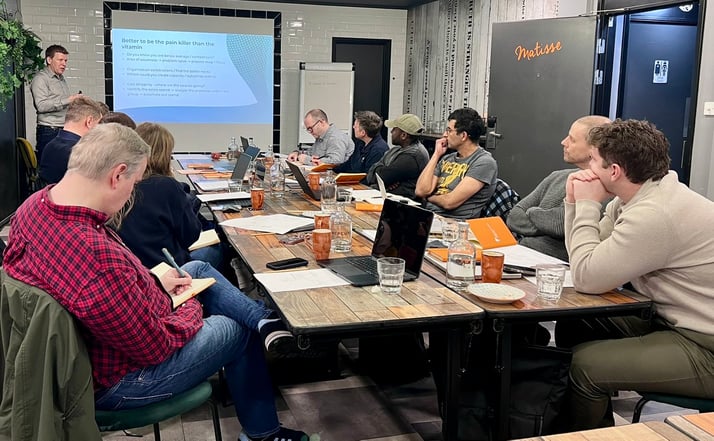
Innovation Visual's AI for Leaders Workshop
And if this has sparked a conversation internally, feel free to share it with colleagues across operations, IT, or leadership. In most organisations, HR ends up playing a central role in how this shift actually gets adopted responsibly. Even starting that conversation early puts you ahead of the curve.